
For more than 20 years in digital marketing, I find that one thing has been fairly consistent for the most part: when we’ve had conversations among small business owners about search and search marketing, we were basically talking about the Google Search Engine because it has been the 600-pound gorilla in the room for a long time. Today, we can say that is no longer the full picture, so your marketing growth strategy can’t stop at Google anymore.
I’m not going to argue or pretend that Google isn’t still incredibly important. In fact, Google says it processes more than 5 trillion searches per year. SEO is not dead, Google is not disappearing, and any business that ignores Google is making a serious mistake. I believe that the people saying SEO is over and talking about apocalyptic changes and the end of Google are just talking nonsense. However, there has been a real change taking place, and it continues to evolve. What has changed is everything happening around Google.
Your customers are searching Google and most likely will continue to use Google for many of their intent and commercial searches, but people are also asking LLMs such as ChatGPT, Perplexity and Gemini. They are searching TikTok and Instagram for recommendations, watching reviews and how-to videos on YouTube, checking Reddit and other forums to see what real people think, discovering products and ideas on Pinterest, and moving between Maps, directories, reviews, social media networks, Ai assistants and company websites before making a decision.
And I think that last point is important for business owners to understand. People aren’t only going to social media to cruise around, watch funny videos or see what their friends are doing anymore. They are searching with intent. They are looking for restaurants, contractors, doctors, attorneys, products, hotels, places to visit, reviews, recommendations, comparisons, answers and solutions to problems. Sometimes that search starts on Google. Other times it starts on TikTok, YouTube, Reddit, Instagram, an Ai platform or somewhere else entirely.
For businesses, especially small and mid-sized businesses, that changes the marketing conversation. The question is no longer simply, “How do we rank higher on Google?” We also need to ask: How do we make sure the business is visible, credible and relevant wherever customers are searching, researching and making decisions?
That requires more than traditional SEO. It requires an Ai Integrated Growth Marketing Strategy.
SEO, Google and Search Marketing Aren’t Dying, but They Are Definitely Being Redistributed
There is a lot of noise right now about the future of Google and whether Ai will eventually replace traditional search. I think a big part of it is people being dramatic and creating a lot of hype, and that misses what is actually happening. Search isn’t disappearing. Search behavior is being redistributed across more platforms, and at the same time the definition of what we consider a search is changing.
Our team is constantly looking at data, information, trends and news, and it’s interesting to see what the numbers are saying. Real data, numbers and statistics tell us a better story and give us a better picture of the present and future than all the predictions and hype. Take a look at these numbers and decide for yourself.
Google says it handles more than 5 trillion searches per year, which works out to at least 13.7 billion searches per day on average. So yes, Google remains massive. But look at what is happening outside of traditional Google Search.
Pinterest reported in 2026 that it has 619 million active users and more than 80 billion searches every month. More importantly from a marketing perspective, Pinterest says approximately half of those searches are commercial in nature. That is more than 40 billion commercial searches in a month on one platform that many businesses still think of primarily as a place for inspiration and pictures.
TikTok says billions of searches happen on its platform every day, and those searches grew more than 40% year over year. TikTok also reports that one in four users starts searching within 30 seconds of opening the app. People may open TikTok to be entertained, but increasingly they also use it intentionally to find products, businesses, restaurants, recommendations, ideas, reviews and answers.
YouTube is another major part of the search equation. People go there to learn how something works, research products, watch reviews, compare options and see a product or service in action before making a decision. For many purchases, particularly more complicated or expensive ones, watching someone explain or demonstrate something can carry considerably more weight than reading another 500-word webpage about it.
Instagram is evolving in a similar direction. Yes, people still use Instagram to follow friends, creators and brands, but discovery and search have become a major part of the experience. Someone looking for a restaurant, a remodeling company, a wedding venue, a cosmetic procedure, a vacation destination or a particular product may intentionally search Instagram because they want to see it, not simply read about it.
Reddit and other forums add another layer because people often go there specifically when they want opinions from other people. A Google search might tell someone which companies sell a particular product. Reddit may help them decide which one they trust. That is commercial intent too, even when the transaction doesn’t happen on Reddit.
What the Data Actually Shows About Commercial Search
The numbers get even more interesting when you look at commercial search behavior across platforms. Rise at Seven analyzed 1.5 billion searches across 9,000 customer journeys, focusing primarily on generic, non-branded commercial-intent keywords across categories including travel, fashion, beauty, technology, automotive, food, gaming, fitness and home and garden.
Their research found that within the search activity they analyzed, Google represented 34.5%, YouTube approximately 24%, Instagram 20.9% and TikTok 16.7%. I would not take those percentages and say that Google only has 34.5% of all searches on the internet because that isn’t what the study measured. What the research does show is how dramatically commercial discovery and search intent can spread across platforms when we follow actual customer journeys instead of looking only at traditional search-engine market share.
The same study found that the average consumer used approximately 3.6 platforms before making a purchase, with buying journeys ranging from two days to ten weeks and involving as many as 97 interactions. For a business owner, that’s the number I would pay attention to. Your potential customer may be researching you and your competitors in several different places before you ever know that person exists.
Ai Is Now Adding Another Search Layer That We Can’t Just Ignore
We have to take LLMs and Ai assistants into serious consideration as part of the search and buying journey. OpenAI reported in July 2025 that ChatGPT users were sending more than 2.5 billion messages per day globally, including more than 330 million per day in the United States.
We should be careful with that number because 2.5 billion messages does not mean 2.5 billion searches. People use ChatGPT to write emails, analyze information, create content, code, learn and perform many other tasks. But people are also asking questions, researching products and services, comparing companies, planning purchases, looking for recommendations and trying to make decisions. A growing amount of commercial research is now happening inside a conversation instead of only inside a traditional search-results page.
We don’t have clean, independently comparable daily search numbers for every LLM, and I don’t think we should make numbers up just to create a bigger headline. What we do have are monthly usage numbers and other statistics that show the scale, progression and direction this is going.
Google announced in August 2026 that the Gemini app surpassed 1 billion monthly active users. Google’s Ai Mode has also surpassed 1 billion monthly users, while Ai Overviews has more than 2.5 billion monthly active users. Those are not direct equivalents of searches, but they show that Ai-assisted information discovery has already reached enormous scale.
Google is also seeing people search differently when Ai becomes part of the experience. The company reports that Ai Mode queries are approximately three times longer than traditional searches, and many sessions become conversational with follow-up questions. That makes sense. Instead of searching “roofing company near me,” someone can now ask:
“Who are the best roofing companies near me that specialize in metal roofs, have strong customer reviews, offer financing and understand Florida hurricane requirements?”
That query tells you a lot more about the person’s intent. They’re not casually browsing. They’re describing what they need and giving the Ai criteria it can use to evaluate potential options. For marketers and business owners, that changes what it means to be visible when a customer is actively looking for a product or service.
Search Intent Is Now Spread Across the Entire Customer Journey
For years, we often thought about digital marketing as a relatively straightforward journey. Someone searches Google, clicks the website, looks around and contacts the company. That still happens every day, but plenty of buying journeys don’t work that way anymore.
Imagine someone planning a major home improvement project. They see a contractor’s work on Instagram. A few days later, they search TikTok for ideas and recommendations. They Google the contractor and read the reviews. They watch a couple of YouTube videos to better understand the project. Maybe they search Reddit because they want opinions from homeowners who have already gone through it. Then they ask ChatGPT, Gemini or Perplexity what they should look for when comparing contractors and what questions they should ask before signing a contract. Eventually they return to Google, visit two or three websites, check another company’s social presence and make a call.
Which platform gets credit for that lead? Maybe Google gets the last click, but Google didn’t necessarily create the discovery, build the trust, answer every question or influence the final decision.
That is why I think businesses need to stop looking at search intent as something that happens only inside a search engine. Intent follows the customer. It can show up on Google, YouTube, TikTok, Instagram, Reddit, Pinterest, Maps, directories, review platforms and LLMs.
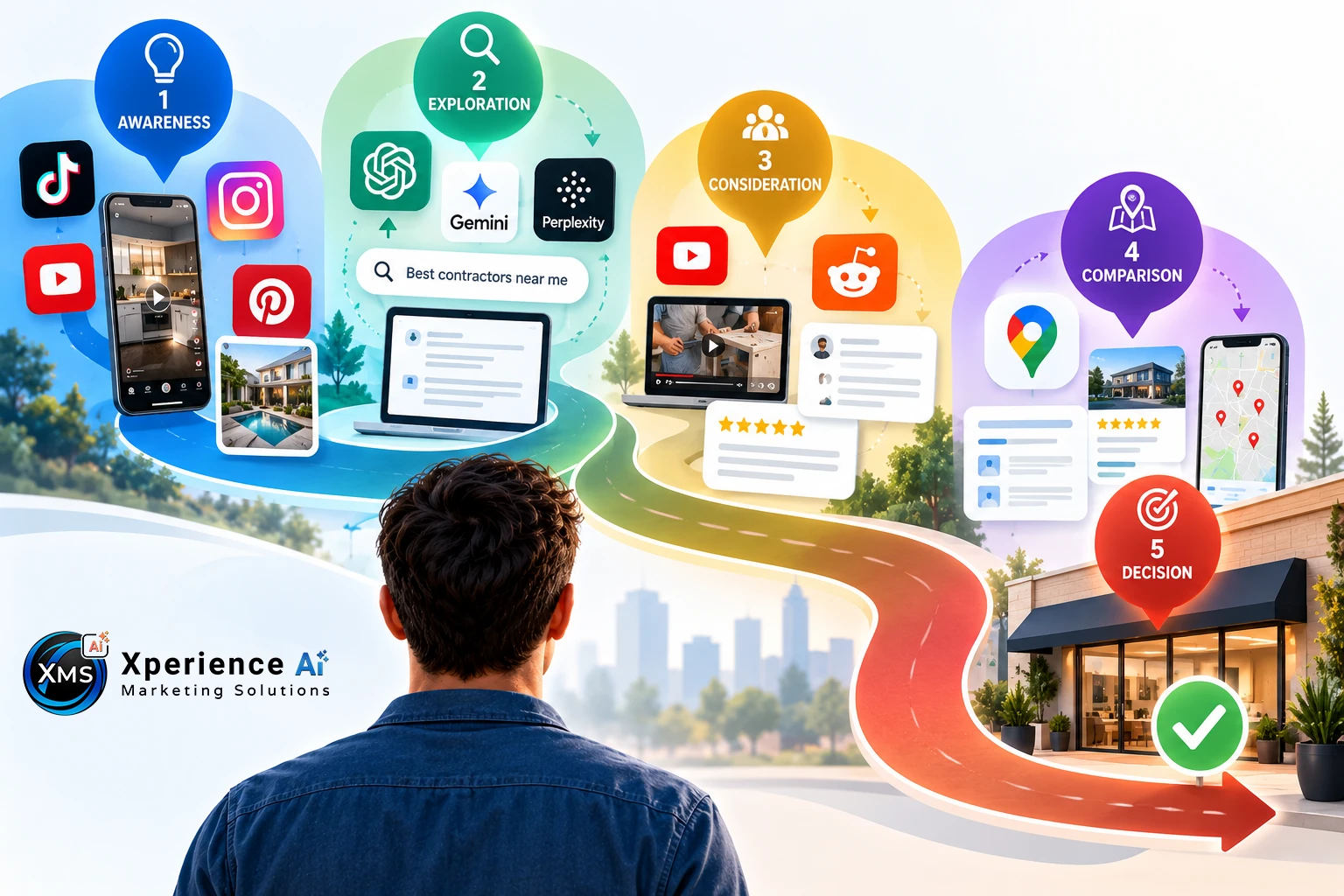
These behaviors may look different from a traditional Google search, but from a marketing standpoint they are part of the same customer journey.
This Is Bigger Than Traditional SEO
Traditional SEO remains a major part of the strategy, and we continue to invest heavily in it for our clients. But SEO by itself cannot carry the entire responsibility for digital visibility anymore.
A business needs to look at its complete digital presence: the website and organic visibility, Google Business Profile and Maps, customer reviews and reputation, social media, video, paid search, paid social, local search, directories, forums, content and Ai answer engines. It also needs to consider whether Google, ChatGPT, Gemini, Perplexity and other Ai systems can correctly understand what the business does, where it operates, what it specializes in and why it may be relevant to a particular customer.
This doesn’t mean throwing money at every channel. It means understanding how the pieces connect and putting the right resources where they can have an impact.
An Ai Integrated Growth Marketing Strategy brings those pieces together around the same business objectives, customer journey and commercial intent. The goal isn’t to create ten separate marketing strategies for ten different platforms. It is to create a comprehensive, intelligent marketing approach where the right channels support each other and work toward the same growth objectives.
Think of it as an all-inclusive 360 approach to marketing, with the strategy, technology, data, content and execution working together instead of operating in separate silos.
Ai Should Power the Marketing Operation, but Humans Still Need to Lead It
One of the mistakes I see businesses making right now is treating Ai as another item on the marketing checklist. They have an SEO strategy, social strategy, advertising strategy and email strategy, and now somebody tells them they also need an Ai strategy. I don’t believe that is where this is heading.
Ai is increasingly becoming part of how the entire marketing operation works. At Xperience Ai Marketing Solutions, we have transitioned into a fully Ai-integrated growth marketing agency. We have built our own Ai ecosystem and have a dedicated in-house Ai development team supporting and powering the different areas of the agency.
But there is another side to that equation that is equally important to us: the work is still human-led, human-managed and human-directed.
Ai can help us analyze search behavior and marketing data, identify opportunities, understand how people ask questions, develop and repurpose content, connect information across channels, automate processes and make our team considerably more capable and efficient. But Ai does not replace strategy, experience, judgment, relationships or the human understanding of a client’s business.
The business owner knows things about the company that aren’t sitting in a keyword research tool. The salesperson knows which objections come up every week. The project manager knows why one service works better in a particular situation. Customers tell you what they value through reviews, conversations and the questions they ask. That real-world knowledge is incredibly valuable. Ai helps us organize it, understand it, expand on it and use it throughout the marketing strategy. We believe in having humans in the loop, not as an afterthought, but as the people directing the technology and making the decisions.
Your Website Still Matters, but Its Job Is Getting Bigger
Because customers are searching across more platforms, some people assume websites are becoming less important. I see it differently. Your website remains one of the few digital properties where you have real control over your brand, services, expertise, content and conversion experience. It also needs to serve as a strong source of information that search engines, Ai systems and potential customers can understand.
Generic content created simply to target keywords is becoming less useful. Businesses need content that answers the questions real customers ask: What makes your company different? Who do you serve? Where do you operate? What does your process look like? What should someone know before making a decision? How does your service compare with alternatives? What questions come up repeatedly during the sales process?
Those answers can become website content, videos, social posts, FAQs, Google Business Profile content, sales material and other assets. The same real expertise can also strengthen the signals that help search engines and Ai systems understand the business. Instead of every marketing channel starting from zero, one piece of genuine business knowledge can support multiple parts of the customer journey. That is integrated growth marketing.
Small Businesses Do Not Need to Be Everywhere
I want to be careful here because the last thing a small business owner needs is another marketing company telling them they now have seven more platforms they need to manage. When we are talking with our clients, we always tell them that they don’t need to dominate Google, TikTok, Instagram, YouTube, Reddit, Pinterest, ChatGPT, Gemini, Perplexity and whatever launches next month.
You just need to understand where your customers are searching, where commercial intent exists for your industry, where people validate their decisions and which platforms actually influence them before they buy.
A restaurant has a very different search journey from a B2B technology company. A roofing contractor has a different journey from an e-commerce fashion brand. A medical practice, law firm, home services company and manufacturer should not have identical marketing strategies.
For many local businesses, Google Search, Google Maps, reviews and the website will continue to capture some of the strongest commercial intent. Protect that position. But maybe YouTube helps customers understand an expensive service before buying. Instagram establishes confidence in the quality of the work. TikTok introduces the business to someone who wasn’t previously aware of it. Reddit helps validate the decision. ChatGPT, Gemini or Perplexity becomes part of the research and comparison process.
The strategy isn’t “be everywhere.” The strategy is to be present where it matters and connect those channels around growth.
Reputation Has a Bigger Role in Ai Search: Reviews, Testimonials and Reputation Management Are More Important Than Ever
Reputation has always mattered in local marketing, and I believe it becomes even more important as Ai becomes part of search and discovery. When someone asks an Ai system to recommend or compare companies, that system needs information it can evaluate. It needs to understand who the business is, what it does, where it operates and whether there is enough outside evidence to support what the company says about itself.
Every company website says the company is great. That’s marketing. What do customers say? What does Google know about the business? Is the information consistent across the web? Are there credible references outside the company’s own website? Does the business demonstrate actual expertise? Are people discussing the company on social platforms, review sites or forums? Can search engines and Ai systems clearly understand its services, locations, specialties and reputation?
This is why reputation management, local SEO, content, structured information, digital authority, social visibility and Ai search optimization are becoming increasingly interconnected. They are no longer isolated marketing activities. Together, they contribute to the larger digital picture and credibility of the business.
From Individual Channels to Comprehensive Ai Integrated Growth Marketing
For years, I’ve seen many local agencies organize themselves around channels. The SEO team did SEO. The social team handled social. Paid media ran advertising. Someone else managed reputation, and another person worked on the website. Customers don’t behave according to those departmental lines. They discover a company on one platform, investigate it somewhere else, validate it through reviews or a forum, watch a video, ask an Ai assistant for additional information and eventually convert through Google, the website, a phone call or another channel. From the customer’s perspective, it is one experience with one business. Marketing should reflect that reality.
This is where an Intelligent Integrated Growth Marketing Strategy becomes much more than another marketing term. The objective isn’t to check every marketing box or be on every platform. The objective is to identify where real search and commercial intent exist for your business and connect the right pieces around growth.
Many People Are Asking Us: As a Local Business Owner, Where Do I Go From Here?
I have been in digital marketing long enough to watch a lot of major shifts happen. Search changed. Social changed. Mobile changed how people interacted with businesses. Google Maps transformed local marketing. Paid advertising became increasingly automated. Now Ai is changing both how people find information and how marketers operate behind the scenes.
Every major change creates the temptation to overreact. Some people freak out. Some businesses chase the newest thing and abandon what was already working. Others ignore the change until their competitors have built a meaningful head start. Neither approach makes much sense.
Keep what works. Google matters. SEO matters. Your website matters. Reviews matter. Good content matters. Relationships still matter. But pay attention to where the intent is moving. People aren’t only scrolling social media anymore. They are searching it. They aren’t only watching YouTube for entertainment. They are researching products and services. They aren’t only visiting Reddit and forums to participate in communities. They are looking for real experiences and recommendations before spending money. And they aren’t only using ChatGPT, Gemini, Perplexity and other LLMs to experiment with Ai. They are increasingly using them to research, compare, evaluate and make decisions.
At Xperience Ai Marketing Solutions, this is where we’re putting a lot of our attention: connecting traditional digital marketing, Ai search, content, local visibility, reputation, paid media, social media and the other channels that matter into an Ai Integrated Growth Marketing Strategy, an intelligent 360 approach based on how customers actually search and behave.
Not Ai because everybody is talking about Ai, and not another platform simply because it is the latest thing. The idea is much simpler than that. Understand where your customers are looking, understand their intent, make sure your business can be found and trusted there, and connect those efforts into a smarter growth strategy.
The future of search isn’t just Google. Search is happening everywhere, and the opportunity is to make sure your business is part of the conversation wherever the right customers are looking, including search engines, forums, directories, social media networks and LLMs.
Xperience Ai Marketing Solutions is a Florida-based, fully Ai-integrated growth marketing agency. We transitioned to this model in early 2025 and have continued developing our own Ai ecosystem, supported by a dedicated in-house Ai development team that works across the different areas of our agency. Our approach combines SEO, local search, Ai search optimization, content, reputation management, paid media, social media and digital strategy under one roof. Ai helps power and optimize the operation, but our people lead it. Strategy, client relationships, creative direction, decision-making and execution remain human-managed and human-directed. For us, having humans in the loop isn’t optional. It’s a fundamental part of how we use Ai responsibly and effectively to help our clients grow.
If you want to understand what an Ai Integrated Growth Marketing Strategy could look like for your business, let’s talk.